


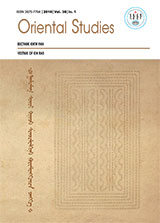
The Oriental Studies (former title is 'Vestnik Kalmytskogo instituta gumanitarnykh issledovaniy RAN' (Bulletin of the Kalmyk Institute for Humanities of the RAS), other versions: "Bulletin of the Kalmyk Institute for Humanities Research", "Oriental Studies (Elista)") — a reviewed scientific journal of open access publishing results of complex researches on Oriental studies issues in the field of historical and philological sciences dealing with history and culture of Eastern peoples and defining their unique sociocultural characteristics.
The Mission of the Oriental Studies journal is to contribute to the development of domestic and foreign Oriental studies; publication of original and translated articles, reviews on oriental studies and reviews of books, collections, conference proceedings and to increase the level of scientific research and development of the international scientific cooperation within current problems of oriental studies.
The journal is published 6 times a year.
The Publisher and Editorial Office of the journal – Kalmyk Scientific Center of the Russian Academy of Sciences.
Articles with partial repetition of the contents published in other journal according to the 'Dissernet' data
Lidzhieva I.V. Financial and economic activity of the institutions of local government in the Kalmyk Steppe in XIX century. Vestnik Kalmytskogo instituta gumanitarnykh issledovaniy RAN (Bulletin of the Kalmyk Institute for Humanities of the RAS). 2015. No. 1. Pp. 16-21. (In Rus.)
Lidzhieva I.V. Economic activity of the branches of public administration of Kalmyk Steppe in the XIX century. Genesis: istoricheskie issledovaniya (Genesis: historical research). 2015. No. 6. Pp. 362-392. (In Rus.)
The article was submitted to the Editorial Office of the Bulletin of the Kalmyk Institute for Humanities of the RAS in 2014, peer-reviewed by the end of the year, and included in issue No. 1 of 2015 in the order of acceptance. The article published by the journal Genesis: istoricheskie issledovaniya (Genesis: historical research) was significantly extended – by 50 % – and revised by the author.
Current issue
ARCHEOLOGY
Introduction. Goals. The article introduces some investigation findings and publishes new materials from the ‘mustached’ kurgans of Northern Saryarka obtained during three field seasons (2022–2024) at the Baubek Batyr-2 and Abakai burial sites. Materials and methods. The paper focuses on archaeological excavation materials from a total of three seasons at the designated sites. The work employs an interdisciplinary approach that comprises tools of remote sensing, morphometric analysis, and those of traditional archaeological research. Results. All the three investigated complexes have been identified as Type Ia according to the Grudochko typology. Particular attention is paid to the application of contemporary methods and techniques, including high-precision geodetic survey, multi-altitude UAV aerial photography, and advanced geoinformation analysis. Data processing in Agisoft Metashape Professional has made it possible to create highly detailed digital elevation models (DEM) and orthophotomaps. The use of the Openness topographic index in SAGA GIS to identify and analyze stone ridges (‘mustaches’) has become a key research element. This has secured the objective identification and mapping of these ritual constructions that are not always discernible during ground surveys. The dating materials for kurgans at Baubek Batyr-2 consisted of ceramic vessels ― a ribbed pot and an imported jug ― as well as results of a radiocarbon analysis into osteal remains conducted at the University in Poznań. Typological analogies and the obtained radiocarbon age (1575 ± 30) make it possible to date the two kurgans to the 5th century AD. The ‘mustached’ kurgan at Abakai with absent material finds is tentatively dated to the 5th–7th centuries AD. The applied interdisciplinary approach has not only refined the dating and cultural attribution of the sites but also demonstrated somewhat high effectiveness of the involved techniques for documenting and interpreting complex ritual sites.
ВСЕОБЩАЯ ИСТОРИЯ
Introduction. The development of professional music education in the Inner Mongolia Autonomous Region throughout the mid-to-late twentieth century is of interest both from historical and art-critical perspectives. The difficult period of state construction would inevitably affect the formation and development of the region’s musical culture. The uniqueness of the situation is that Inner Mongolia’s musical traditions have been simultaneously influenced by Chinese musical art and European (Soviet) school of professional training. Goals. The paper examines some features inherent to the development of professional music education in the region, and characterizes the government’s sociocultural policies in the specified period. Materials and methods. The study focuses on documents, decrees, decisions of China’s cultural affairs leadership, as well as documents adopted by the Government of Inner Mongolia. The work basically employs the problem-chronological and historical comparative approaches. Results. As the first ethnic autonomy of the PRC destined to equally experience large-scale nationwide transformation plans, the Inner Mongolia Autonomous Region did prove a particular case of ethnocultural development. Mongolian musical traditions served as a source for the creation of new patterns in the to-be-modernized society. Plot and compositional structures of original works from the designated period would comprise both classical canons and new motifs introduced by Soviet composers. Conclusions. The Soviet Union helped China not only create new systems of general and higher education, develop the social sphere at large, but also contributed to the shaping of professional music education. The cooperation between Soviet and Chinese specialists was pinnacled by the establishment of the Inner Mongolia Symphony Orchestra.
NATIONAL HISTORY
Introduction. The present days witness an increasing interest in the history (and historiography) of Buddhist temples, since the latter are still being restored all cross ethnic Buryatia where the bulk of them had been destroyed in the 1930s. The study is first to publish the official correspondence between Pandita Khambo Lama and Military Governor on repair and reconstruction works for Buddhist temples. The archival files and records reveal the complicated transformation processes of Buddhist architecture. Goals. The work seeks to identify particulars of Buddhist temple construction at the turn of the twentieth century, and introduce into scientific circulation some newly discovered materials on the history of Buddhist religious construction. Materials. The study examines documents from the Russian State Historical Archive and Buryatia’s State Archive dealing with communications regarding repair arrangements for various datsans from across ethnic Buryatia. Results. Files of correspondence concerning each datsan would prove unique enough and include a public decision of parishioners, a physical quantity survey, decrees of the abbot and Khambo Lama and other materials that reflect the interaction between authorities and Buddhist community on the designated issues. The publication of such documents shall fill in certain gaps in the history of Buddhist temple construction. Conclusions. The late nineteenth and early twentieth centuries were the heyday of Buryat temple construction. The period gave rise to multiple petitions for temple repair works, and public executives in cooperation with Buddhist community would find ‘architectural compromises’ when it came to tackle contestable aspects ― through lengthy correspondence. So, Buddhist temples and their architectural transformations would shape a point for interaction between officials and Buddhist community.
Introduction. The formation of professionals as a stratum in ethnic republics and regions became a strategic direction of the korenizatsiia in the first decades of the Soviet era. Goals. The article aims to identify some features of ethnic professional training and the shaping of the vocational education system in Kara-Kirghiz Autonomous Oblast, Kirghiz Autonomous Oblast, and Kirghiz Autonomous Soviet Socialist Republic throughout the 1920s. Materials and methods. The study primarily deals with documents from the Central State Archive of the Kyrgyz Republic (collection ‘Kirghiz ASSR People’s Commissariat for Education’) and other sources. The conducted analysis rests on the classical research principles of historicism and objectivity, employs the general scientific, statistical, comparative historical, and problem-chronological methods. Results. The severe shortage of native professionals and absence of vocational schools forced the RSFSR People’s Commissariat of Education to send young residents of Kirghizia ― on a centralized basis ― to educational institutions of other regions. The targeted student recruitment program of the 1925–1926 and 1926–1927 academic years involved 728 individuals. The bulk of the latter were ethnic Kyrgyz from poorest social strata (peasants, farm laborers, workers). And most of the allocated funds would be used for sustenance scholarships. The formation of a professional education system in the ethnic autonomy included efforts for the establishment of various educational institutions with different specializations. The educational mobilization of youths during the specified period laid the foundation for the would-be ethnic intelligentsia and provided required conditions for the modernization of Kyrgyzstan throughout the decades to come.
Introduction. The article contains an analysis into the conditions experienced by labor conscripts from Central Asian Military District at plants and factories of the Urals during the Great Patriotic War. The topic has remained virtually unattended in the Soviet era, and present-day historiographers tend to consider it in regional perspectives. Results. The paper shows the labor mobilization ― in particular, across Central Asian republics ― played an important role in the functioning of war-related industries. However, the revealed facts attest to executives of such recipient enterprises were not ready to employ the significant numbers of workers with meager or even absent industrial qualifications and skills. Other adaptation hindering factors for Central Asians at factories and construction sites of the Urals included lack of Russian fluency, unusual weather and living conditions, inattention of executives to newcomers, their difficulties and interests. Insufficient attention would be paid to safety regulations, outdoor temperature control, etc. The miscalculations resulted in low labor motivation, cases of absenteeism and desertion, illnesses and even deaths. These led to numerous complaints that forced the authorities to initiate inspections of involved executives and certain subdivisions (workshops). The paper shows the inspections did have certain positive effects, which included not only some formal safety-related sessions but also industrial training of labor conscripts and even expansionary measures. It is concluded that the conditions of Central Asian labor conscripts did improve by 1944–1945, which enhanced the latter’s efficiencies.
ETHNOLOGY / ANTHROPOLOGY
Introduction. The article discusses sacred texts preserved in the form of rock inscriptions in Barun-Khemchiksky District of the Tyva Republic. Goals. The work aims to demonstrate how the religious renewal intersects with mechanisms of cultural memory, local identity policies, and reinterpretations of historical heritage. Materials and methods. The study focuses on original field data, museum collections, and archival materials. The work employs the chronological method to identify some cause-and-effect relations for Buddhist rock inscriptions, while the archaeological epigraphic one helps describe the forms, applied techniques and preservation conditions of the inscriptions. Results. The paper examines the typology of inscriptions (canonical formulas, memorial fixations), their locations within corresponding landscapes (passes, river mouths, routes to sacred mountains, ritual sites), and their ties with cult objects — stupas and stone slabs. It notes that the return to Buddhism is perceived as an appeal to the cultural and spiritual roots. This enhances interest to Buddhist epigraphic monuments located in sacred sites, since the former serve an important source for the study of religious beliefs, artistic traditions, and spiritual life across various historical periods. Buddhism has deep historical roots in the territory of present-day Tuva, and occupies a special place in the region’s spiritual culture. The Tuvan sacred space would take shape at the intersection of shamanic and Buddhist traditions, which is reflected in a multitude of material monuments — from temple complexes and stupas to stone slabs with epigraphic texts. The study shows certain forms of their interaction, transformations of ritual landscapes, restorations and creations of cult objects, paralleled by expanded research interest to epigraphy in the post-Soviet era. The Buddhist inscriptions on rocks, stones or steles serve not only written monuments but also unique markers of sacred space. They indicate places of worship, simultaneously act as objects of religious veneration and, thus, prove sufficient sources for the study of cultural processes. Conclusions. The attempted insights have shown that the territory of Barun-Khemchiksky District and adjacent municipalities of Tuva constitute a unique sacred space formed by centuries-long interactions of natural, cultural and religious factors. Buddhist inscriptions, petroglyphs, and religious images are by no means isolated from each other here, but rather form a unified epigraphic and iconographic landscape that reflects the continuity of the region’s spiritual traditions.
Introduction. The article examines the peculiarities of the spread and perception of geek culture in the comic book format and the shaping of identity among Kazakhstan’s teenagers on this basis. The relevance of the research is substantiated by the rapid development of subcultures on a global scale and their competition for influence and creative content with the media. The topic is also interesting in the context of the sociocultural development of the younger generation of Kazakhstan. Goals. The article aims to analyze the peculiarities of the consumption of comic book culture and the super subculture of geeks by the youth audience of Kazakhstan (aged 12 to 16) in relation to the shaping of their identity. Materials and methods. The study explores materials collected in 2022–2024 and involves such tools as descriptions, reviews (theoretical basis), surveys (questionnaires), analyses, and statistical methods. Results. The research reveals both positive and negative factors of the impact of comics and geek culture on teenagers in Kazakhstan: positive self-image through socialization with a group of comic book fans, the desire for interaction, the development of imagination but also — decreased self-esteem and crisis of self-identification, response to comic book images (mirroring of ‘I’), imitation of characters, the formation of a ‘geek identity’ through manipulation and simulacra. Conclusions. The works defines the types of geeks and various forms of adolescent identity, such as advertising, artificial, occupational ones. The concept of ‘geek identity’ (according to E. Erikson) is considered as a form of identification of a person (self-identity) with the media industry, awareness of belonging to a certain group of fans, and a way of mastering reality.
Introduction. The article treats tourism as a form of temporary cross-border migration and examines how visitors from former Soviet states have shaped Thailand’s tourism landscape across pre-pandemic growth, the COVID-19 collapse, and a robust, uneven recovery. It focuses on how visa regimes, flight connectivity, payment channels, and geopolitical shocks condition volumes, profiles, and destinations within Thailand. Goals. The paper aims to identify current trends and development prospects of tourist migration from former Soviet states to Thailand; profile socio-demographic and spatial patterns; and estimate the economic contribution of key markets (notably Russia, Kazakhstan, and Ukraine). Materials and methods. A mixed-methods design combines quantitative analysis of official Thai tourism statistics (2014–2024, with early-2025 where available) by nationality, province and visitor profile; a targeted online survey of Russian, Kazakh and Ukrainian visitors to derive per-diem expenditure and length of stay; policy and visa document review; and macroeconomic benchmarking (GDP). A tourism-contribution formula aggregates per-capita spend over stay length and arrivals to approximate direct GDP shares. Results. Tourist inflows from former Soviet states collapsed in 2020–2021 and rebounded by 2023 to roughly pre-pandemic levels, with Russia remaining the bellwether, Kazakhstan emerging as the second growth pole, and Ukraine’s outbound travel constrained by conflict. The age profile centers on 25–44 with a slight female majority, and travel concentrates in coastal hubs — especially Phuket and Pattaya — though independent travel is widening the footprint to secondary provinces. Estimated direct GDP effects are material — on the order of one percent driven chiefly by Russian visitors — while policy levers (visa facilitation, frictionless payments, flight capacity) and risks (sanctions, exchange-rate volatility) shape near-term prospects. Strategic recommendations include maintaining facilitative entry, diversifying origin markets, encouraging dispersal beyond saturated hubs, and embedding sustainability and risk management into destination strategy.
Introduction. Managerialism implies a value system that contradicts any professional teacher culture. It is based on the ideas of formalized educational processes, increased administrative control, commercialization, and competition. These give rise to deformations of basic behavioral patterns inherent to teacher community, which is essentially destructive to the eastern parts of our country where such culture had been shaped through a comprehensive variety of factors and conditions that are incompatible with formalized rationalizations of present-day managerialist practices.The being destroyed qualities include as follows: abilities to provide systemic education, foster a harmoniously developed personality, instill senses of citizenship and patriotism, willingness to perceive one’s profession as a lifelong calling, and maintenance of universal and professional attitudes that help one treat students as individuals rather than as reporting units. Goals. The study seeks to reveal cause-effect relations between managerism in secondary school management and deformations of professional teacher culture that lead to the destruction of national culture, pragmatization of consciousness, and increased asymmetries between the federal center and regions. Materials and methods. The study introduces outcomes of a mass survey that involved a total of 1,500 teachers and was conducted in four climatically semiarid regions of Russia, namely: Republic of Kalmykia (N=361), Astrakhan Oblast (N=365), Stavropol Krai (N=380), and Rostov Oblast (N=394). The key sampling principle is that of quota (proportion). The distribution was made through the use of an online calculator that defined the required numbers of respondents on the basis of the general population with a confidence interval of 95%. The quotas are based on Rosstat’s data on teacher numbers in the four specified regions. Results. The introduction of managerism-type tools has led to the profession of teacher ceases to be a lifelong vocation and tends to turn into a regular job aimed at earning money, which thus — if insufficient — can be easily changed for a financially more attractive one. Efforts of teachers are being formalized, standardized, which inevitably compromises their professional culture. Conclusions. Elimination of factors that deform teacher professional culture is virtually impossible within the current managerialist model.
SOURCE STUDY
Introduction. The article presents an analysis into scholarly works, archival materials and periodical editions dealing with the passportization of Tuvans in the era of the Tuvan People’s Republic and Soviet Tuva. Goals. The paper attempts a historiographic review of sources that can shed light on the passportization of Tuva’s citizens. No special studies have been conducted on the passportization of Tuva’s population or its consequences due to unavailability of related materials, which makes the insight relevant enough. Materials and methods. The study focuses on nationwide studies of passportization processes in the Soviet Union selected for drawing parallels with the passportization of Tuva’s population, as well as on works of Tuvan researchers who have turned to some aspects of the issue. The key findings have been secured by insights into archival documents and periodicals of the Tuvan People’s Republic and Soviet Tuva (1940s) that have proved most instrumental in tracing certain stages and essentials of the passportization processes. The involved original field data help understand some anthroponymic consequences of the passportization. The study rests on the principle of historicism and objectivity that reveal the designated processes in their historical development. The comparative historical method has been used to analyze the TPR’s passportization with due regard of certain aspects of similar processes in the Soviet Union at large. Results. The first group of sources consists of scholarly works dealing with nationwide issues and examining various aspects of passportization in the USSR. The second group of sources consists of works by Tuvan authors. However, these works address the topic in question indirectly, fragmentarily, as part of research on other topics and nothing more. Nevertheless, these scholars’ efforts are crucial for identifying key areas of concern in the aspect under study. Finally, the third group of sources includes regulatory archival documents and periodicals from the Tuvan People’s Republic and Soviet Tuva. Insights into these documents completely reconstruct the passportization process, which makes it possible to identify its key stages and results, including those related to Tuvan anthroponymy.
LINGUISTICS / LITERATURE STUDIES
Introduction. In any language, everyday speech structures include not only lexical and grammatical levels. A significant role is played by nonverbal characteristics of the sound chain, such as stress, intonation, and paralinguistic aspects. So, vocalizations and sound artifacts should also be recognized as integral properties of oral speech. Goals. The study aims to examine such artifacts often associated with speech production, namely: tongue clapping, smacking and noisy inhalation of air, or slurping. These features are not purely physiological and prove functionally loaded during communication, which makes them an interesting object of linguistic research. The study identifies their functional varieties and phonetic correlates. Materials and methods. Our instrumental analysis has covered a total of 277 sound artifacts extracted from Russian oral monologues of 20 Chinese speakers. Results. The analysis describes all the identified sound artifacts by duration, articulation pattern, and position in the speech stream in relation to other units. Conclusions. In addition to the three types of sound artifacts identified prior to the instrumental analysis (from transcripts), the study describes three more varieties of similar phenomena ― smacking/clacking sounds preceded by swallowing, and two types of smacking/clacking sounds associated with inhalations. It is believed that the obtained data may be instrumental in such applied aspects of linguistics as colloquialism, forensic linguistics, and automatic processing of natural speech. The presence of the phonetic phenomena discussed in the study still significantly distinguishes natural speech from that generated by artificial intelligence systems.
Goals. The study compares the suffix {+čAn} used as a noun derivational suffix in most Turkic languages ― and the suffix {-čAn} which forms participles and is used as a verb conjugation suffix in the Khakas and Shor languages, with an emphasis on the relationship of these suffixes to the suffix {-(V)wčAn} which is used as a verb conjugation suffix in the Karachay-Balkar language. The structure and origin of the suffix {-(V)wčAn} in Karachay-Balkar is then discussed. Results. When analyzed in the context of historical sound events, it is clearly understood that the suffix {-(V)wčAn} in Karachay-Balkar undoubtedly arose as a result of a merger of the suffix {-(V)G} which was used to form nouns from verbs in the Old Turkish period ― and the suffix {+čAn} which forms nouns from nouns and whose exact time of emergence cannot be determined. In brief, it is possible to explain this as {-(V)G} > {-(V)w}+{+čAn} > {-(V)wčAn} with the historical {G}>{w} sound change seen in many Turkic languages. Based on this information, the development of the suffix {-čAn} which is used as a verb conjugation suffix in Khakas and Shor can also be clarified. The analysis into Karachay-Balkar-language literary writings shows that the suffix {-(V)wčAn} is used only as a verb conjugation suffix, losing its noun-forming and participle-forming features. The work also addresses the participle-forming phase of this suffix (before it became a verb-conjugation suffix) and identifies traces of this function in present-day discourses. As a verb conjugation suffix, this suffix is mostly used in expressions in the simple present tense with simple and compound verb conjugations and sometimes, particularly in conditional sentences, as a tense modal expressing the present continuous tense.
Introduction. Contemporary paremiology views paremies as complex semiotic and linguoaxiological units that reflect worldviews and values of a certain ethnic group. Chinese paremiology, with its rich tradition, constitutes a multifaceted system characterized by interactions between structural, semantic, and cultural levels. Goals. The article aims to identify some systemic properties of the Chinese paremiological corpus, determine the nature of interrelations among paremic units, and uncover their axiological and cultural-cognitive potentials. To facilitate these, the work shall describe the formal and semantic patterns of paremies, analyze their variants, identify universal and culturally marked components, and examine the pragmatic and metatextual functions of Chinese paremies. Materials and methods. The study focuses on approximately 1,500 Chinese paremies selected from authoritative dictionaries, the authors’ personal card indices, and literary texts (in particular, Cao Xueqin’s novel Dream of the Red Chamber). The research methodology is based on modern approaches rooted in postulates of the theory of phraseology, linguocultural studies, linguoaxiology, as well as the descriptive analytical method and those of component, comparative contrastive and pragmatic analyses. Results. The study reveals the presence of systemic relationships in Chinese paremiology, including synonymic, antonymic, and hyper-hyponymic connections, along with significant variability. Both universal (anthroponyms, toponyms, zoonyms, chrononyms) and ethnospecific elements are identified as carriers of cultural constants. The analysis demonstrates that Chinese paremias exhibit a high degree of functional flexibility, thus fulfilling normative, identificational, and poetic functions. Conclusions. Chinese paremiology shows properties of a semiotically closed and cognitively rich system, in which forms, meanings, and values are closely interrelated. Paremias function as tools for conceptualizing the world, preserving ethnocultural knowledge, and transmitting values. The findings of the study may be applied in cross-linguistic paremiological comparisons and in practices of linguistic and cultural mediation.

ISSN 2619-1008 (Online)





